How to Choose the Best Loan Origination Software: A Lender's Guide
Nov 2, 2026
Is your loan origination system driving efficiency? Or creating operational bottlenecks?
For many lenders, fragmented systems, manual workflows, and aging infrastructure create operational bottlenecks that increase processing costs, limit visibility, and make scaling more difficult. These challenges can affect everything from underwriting efficiency to compliance oversight and the borrower experience. As lending operations expand, technology leaders must determine whether their existing systems can support evolving business demands.
Choosing loan origination software (LOS) is therefore a strategic business decision, not simply a technology replacement. The best loan origination software must align with your lending channels, product portfolio, integration requirements, and regulatory obligations while supporting long-term growth.
This guide examines the critical factors lenders should evaluate before selecting an LOS, including API flexibility, unified data architecture, workflow automation, governed AI, cloud security, and total cost of ownership. The goal is to help lending leaders look beyond feature lists and identify a platform built around their operational priorities and future ambitions.
Define Your Lending Requirements Before Evaluating Software
Before comparing vendors, identify your operational challenges, lending requirements, and growth objectives. A loan origination system (LOS) that works for one lender may not support another's product complexity or workflows. Document your current processes, identify performance gaps, and prioritize essential capabilities to ensure your investment addresses immediate needs while supporting long-term business goals.
- Match the LOS to Your Lending Channels: Retail, wholesale, correspondent, and housing finance agency (HFA) lending involve different workflows, approval structures, and documentation requirements. Begin by mapping each lending channel from application intake through underwriting, closing, and handoff to servicing. For every channel, identify the required workflows, user roles, approval rules, and third-party connections. During vendor evaluations, ask whether these processes can be configured within the same platform or require separate modules, custom development, or external applications. Evaluate how easily users can manage exceptions, change workflows, and access loan information across channels.
- Evaluate Support for Your Loan Portfolio: Identify the loan products you currently offer and plan to introduce over the next three to five years, including conventional, FHA, VA, USDA, HELOC, construction, chattel, and business-purpose loans, where applicable. Document each product's eligibility rules, documentation, approval workflows, and reporting needs. Ask vendors to demonstrate how their LOS supports these requirements and distinguish native features from customization or third-party integrations. Clarify the costs and development effort required to introduce new loan programs.
- Document Current Pain Points and Future Goals: Identify bottlenecks such as duplicate data entry, manual handoffs, disconnected applications, and reporting delays. Establish baseline metrics, including processing times, error rates, and cost per loan, where data is available. Define measurable improvement targets and classify requirements as mandatory, important, or optional. Use a consistent vendor scorecard to document capabilities, request supporting evidence, and compare demonstrated performance against your operational priorities.
Evaluate API Flexibility and Third-Party Integrations
Your loan origination system must exchange data reliably with the tools your lending operation depends on. Weak integration capabilities can create data silos, increase manual work, and drive up maintenance costs. Before selecting a platform, assess its API documentation, data exchange capabilities, integration management processes, and ability to accommodate new technologies without extensive redevelopment.
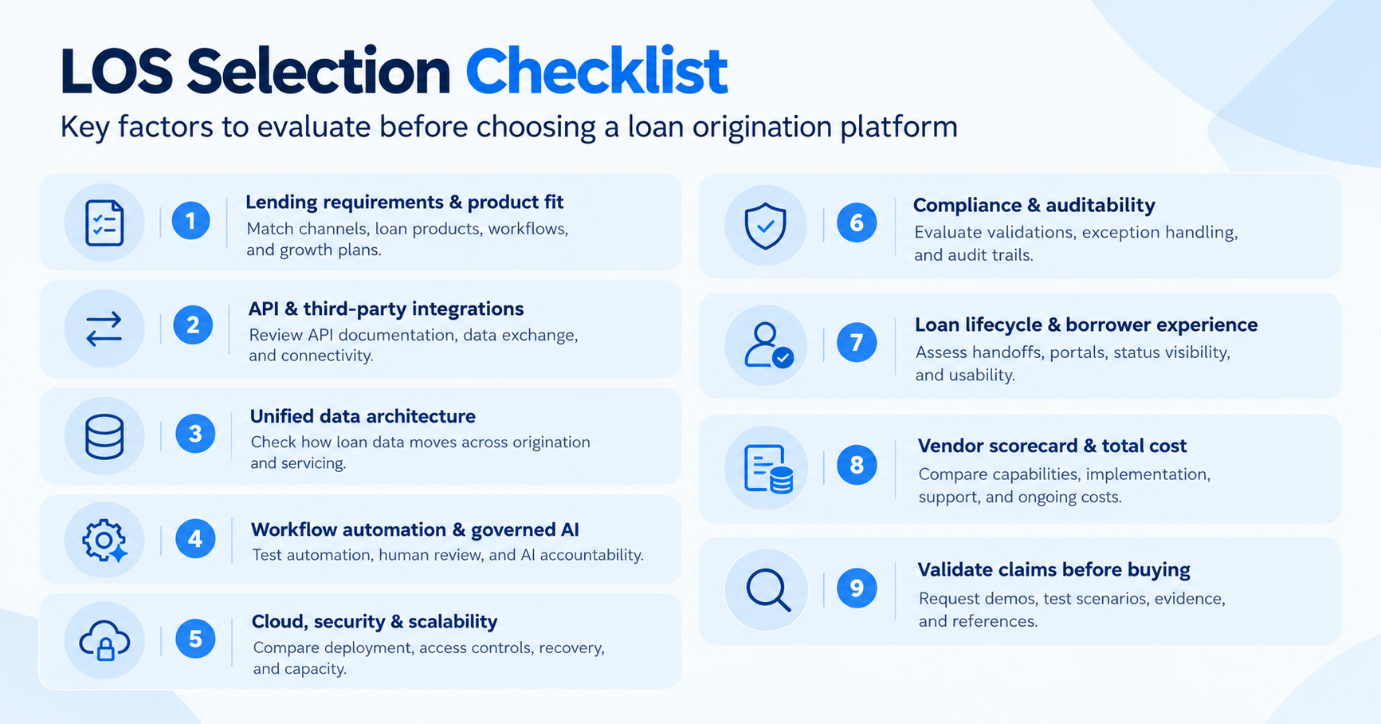
LOS Selection Checklist
| # | Item | Description |
|---|---|---|
| 1 | Lending requirements & product fit | Match channels, loan products, workflows, and growth plans. |
| 2 | API & third-party integrations | Review API documentation, data exchange, and connectivity. |
| 3 | Unified data architecture | Check how loan data moves across origination and servicing. |
| 4 | Workflow automation & governed AI | Test automation, human review, and AI accountability. |
| 5 | Cloud, security & scalability | Compare deployment, access controls, recovery, and capacity. |
| 6 | Compliance & auditability | Evaluate validations, exception handling, and audit trails. |
| 7 | Loan lifecycle & borrower experience | Assess handoffs, portals, status visibility, and usability. |
| 8 | Vendor scorecard & total cost | Compare capabilities, implementation, support, and ongoing costs. |
| 9 | Validate claims before buying | Request demos, test scenarios, evidence, and references. |
Evaluation tip: Ask each shortlisted vendor to demonstrate one critical integration using a realistic lending workflow. Record the results, identify unresolved dependencies, and compare findings against your technical and business requirements before selecting a platform.
Single-Database vs. Connected Legacy Architecture: The Same Loan, Two Approaches
Consider a mortgage loan approved for $350,000. Once the loan closes, its borrower details, loan terms, documents, and payment information must be available to the servicing team.
- In a connected legacy architecture: Origination and servicing may operate on separate databases. Loan information must be transferred through an integration, file export, or synchronization process. If a field is missing or a transfer fails, teams may need to investigate discrepancies and reconcile records. Reporting across both systems may also require additional data consolidation.
- In a unified data architecture: Origination and servicing can access shared loan data through natively integrated workflows. Depending on the platform's design, this can reduce duplicate data entry, simplify handoffs, and improve visibility across the loan lifecycle. Appropriate permissions, validation rules, and audit trails remain essential.
| Evaluation point | Connected legacy systems | Unified data architecture |
|---|---|---|
| Loan data transfer | May require separate integrations or batch processes | May use shared data and integrated workflows |
| Data discrepancies | Can require cross-system reconciliation | Can reduce discrepancies caused by duplicated records |
| Reporting | May require consolidating data from multiple systems | May provide more consistent cross-functional reporting |
| Maintenance | Multiple interfaces may require ongoing support | Fewer interfaces may reduce maintenance, depending on design |
| Security | Controls must be coordinated across systems | Access controls must still be enforced across shared data |
What lenders should verify: Ask vendors to demonstrate this loan handoff, including failed transfers, data corrections, reporting, and access permissions. A shared database does not guarantee real-time updates or eliminate every integration. Validate the actual data flows, recovery procedures, and security controls before comparing architectures.
Assess Workflow Automation and Governed AI Capabilities
Manual processes can slow loan processing, increase data-entry errors, and limit a lender's capacity to handle growing volumes. When evaluating the best loan origination software, assess how automation and AI can improve operational efficiency while preserving appropriate human oversight, accountability, and regulatory controls. Focus on measurable performance improvements rather than the number of automated features a vendor offers.
- Identify Opportunities for End-to-End Workflow Automation: Map repetitive tasks across application intake, document collection, task assignment, approval routing, and status updates. Ask vendors to demonstrate how the LOS triggers actions, assigns responsibilities, and escalates incomplete applications or exceptions. Verify that business rules can be configured to match your lending policies and that employees retain appropriate control over critical decisions. Measure potential improvements in processing time, manual touchpoints, and exception resolution.
- Evaluate AI for Document Processing and Underwriting Support: Assess AI capabilities for document classification, data extraction, field validation, and discrepancy detection. Request testing with representative loan files to measure extraction accuracy, identify common errors, and determine how the system handles incomplete or inconsistent information. Ask how confidence thresholds trigger human review and whether underwriting support can be explained and independently verified. AI-generated outputs should not automatically determine consequential lending decisions without appropriate controls and review.
- Verify AI Governance and Accountability: Before deployment, establish how borrower data is collected, processed, retained, and shared with third-party AI providers. Ask vendors about access restrictions, model updates, output traceability, and safeguards against unauthorized data use. Verify whether decisions and material recommendations can be documented and audited, and whether the system supports monitoring for performance disparities. Define who reviews errors, approves model changes, and remains accountable for lending decisions.
Practical evaluation: Run a controlled pilot using representative loan files. Compare automated outputs against verified results, document error rates, measure time savings, and test exception handling before expanding deployment.
Key takeaway: Choose automation and AI capabilities based on demonstrated accuracy, operational value, governance, and suitability for the intended use. Technology should strengthen lending operations without replacing necessary human judgment or compliance oversight.
Cloud-Based vs. On-Premise Loan Origination Software
Your LOS deployment model affects infrastructure costs, system availability, security responsibilities, and the ability to accommodate business growth. When comparing cloud-based and on-premise solutions, evaluate how each option aligns with your operational requirements, IT resources, and risk management policies. Focus on documented capabilities and long-term costs rather than assuming one deployment model is automatically superior.
| Evaluation factor | Cloud-based LOS | On-premise LOS |
|---|---|---|
| Infrastructure | Hosted by a cloud provider or vendor | Hosted in the lender's own environment |
| Maintenance | Infrastructure management is largely handled by the provider | Lender manages more infrastructure and maintenance responsibilities |
| Scalability | Capacity can often be adjusted as demand changes | Expansion may require additional hardware and configuration |
| Updates | Managed according to the vendor's release model | Often scheduled and deployed by the lender or its service provider |
| Security | Shared responsibilities between lender and provider | Greater direct infrastructure control, with more responsibilities retained internally |
| Cost structure | Typically recurring subscription or hosting fees | May include hardware, licensing, staffing, and upgrade costs |
What lenders should evaluate: Ask vendors to document infrastructure responsibilities, update schedules, security controls, recovery capabilities, and all associated costs. Cloud deployment does not automatically guarantee lower costs or stronger security, and on-premise deployment does not necessarily provide greater control over every application-level function. Compare both models against your organization's IT capabilities, risk requirements, and long-term operating budget.
Verify Native Compliance and Regulatory Controls
Compliance should be a core selection criterion when evaluating loan origination software. Look for built-in controls that support consistent processes, maintain audit trails, and help identify potential issues. Software can support compliance efforts, but it cannot guarantee compliance or replace appropriate oversight.
- Assess Support for HMDA, TRID, and RESPA: Support for HMDA (Home Mortgage Disclosure Act), TRID (TILA-RESPA Integrated Disclosure), and RESPA (Real Estate Settlement Procedures Act) is a critical function in the mortgage and financial services industries.
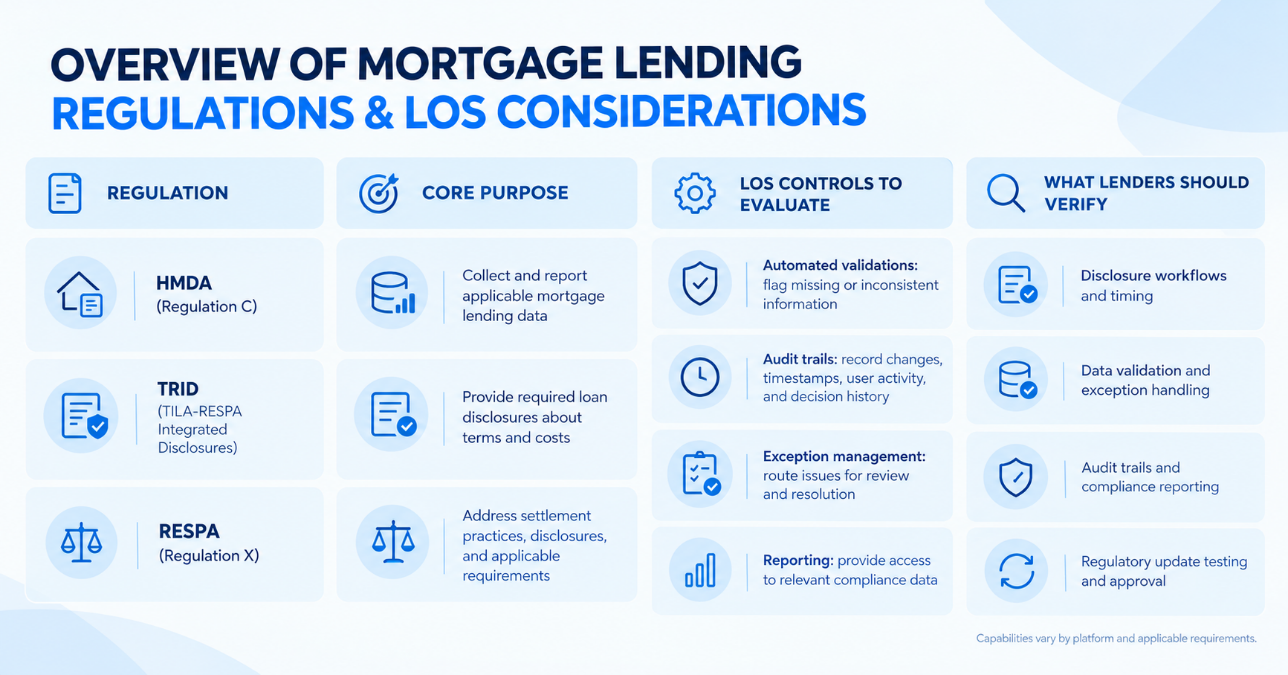
Note: These are evaluation areas, not a guarantee that every LOS provides each capability natively. Specific requirements depend on the institution, transaction, product, and applicable regulations.
- Evaluate Compliance Controls Within Workflows: Look for controls that help teams identify and resolve issues during the lending process, rather than relying entirely on manual reviews.
- Automated validations: Flag missing information, inconsistent data, or potential exceptions.
- Audit trails: Record relevant changes, timestamps, user activity, and decision history.
- Exception management: Route issues to appropriate staff for review and resolution.
- Reporting: Provide access to relevant compliance data without excessive manual exports or disconnected spreadsheets.
Ask vendors to demonstrate how an exception is flagged, assigned, resolved, and documented.
- Understand How Regulatory Changes Are Managed: Regulatory requirements evolve, so ask how vendors communicate, test, document, and deploy relevant updates. Determine whether compliance teams can review and approve rule changes before production release. Request release notes, sample test scenarios, and evidence showing how updates affect existing workflows.
Clarify whether updates are included in the contract or require additional configuration, services, or third-party support.
Practical evaluation: Involve compliance, operations, and IT teams in a scenario-based demonstration. Test disclosure workflows, data validations, exception handling, audit trails, and reporting. Document gaps, manual workarounds, and dependencies that need further review.
Key takeaway: An LOS can support compliance processes, but lenders remain responsible for determining applicable obligations, configuring and validating systems, reviewing outputs, and seeking qualified compliance or legal advice when necessary.
Evaluate the Full Loan Lifecycle and Borrower Experience
Choosing the best loan origination software requires looking beyond application processing and evaluating how the platform supports the broader lending lifecycle. Connected workflows can help reduce manual handoffs, improve data visibility, and create a more consistent experience for borrowers and employees.
- Look for Continuity From Origination to Servicing: Assess how loan data, documents, and workflow statuses move from origination to servicing and other supported functions, including default management, document management, and reporting. Determine whether these capabilities operate within a unified platform or depend on separate systems and integrations.
- Test the Borrower and Employee Experience: A well-designed LOS should make it easier for borrowers to complete applications, submit documents, receive updates, and understand next steps. Evaluate application accessibility, communication workflows, and status visibility across supported channels.
Assess usability for loan officers, processors, underwriters, compliance staff, and servicing teams.
Practical evaluation: Test representative loan scenarios from application through servicing. Measure processing time, manual handoffs, data discrepancies, borrower completion rates, and employee support needs where baseline data is available.
Key takeaway: Evaluate the platform's ability to support connected lifecycle workflows and a consistent user experience. Verify integration depth, functionality, and measurable operational benefits rather than assuming that a broader feature set automatically delivers better outcomes.
Build a Vendor Scorecard and Validate Claims Before Buying
Use a weighted scorecard to compare vendors consistently. Rate each criterion from 1 to 5, then adjust the weights to reflect your lending priorities.
Use a Weighted LOS Evaluation Scorecard
| Evaluation criterion | Suggested weight |
|---|---|
| Lending channel and product fit | 15% |
| API and integration flexibility | 15% |
| Data architecture and lifecycle integration | 15% |
| Workflow automation and governed AI | 15% |
| Compliance and auditability | 15% |
| Security, deployment, and scalability | 15% |
| Total cost of ownership and vendor support | 10% |
| Total | 100% |
These weights are illustrative, not industry benchmarks.
Compare Evidence and Finalize Vendor Selection
- Validate vendor claims: Request documented evidence for capabilities that influence your decision.
- Compare total costs: Review implementation fees, recurring charges, customization, and ongoing support.
- Check vendor accountability: Confirm implementation milestones, support SLAs, and responsibility for resolving issues.
- Verify references: Speak with comparable lenders about implementation experience and ongoing support.
Why Lenders Should Consider a Unified Platform Like LoanQuest
MortgageFlex Systems' LoanQuest (LQ) is built on a shared technology foundation that brings origination, servicing, and default management together rather than treating them as separate products. Its key differentiators include:
- One shared architecture: Origination, servicing, and default solutions use the same underlying platform, supporting shared data models, workflows, documents, and reporting across the loan lifecycle.
- Eight shared platform services: The LQ Foundation includes workflow orchestration, AI agent governance, API creation, reporting and analytics, document management, document generation, customization, and Azure cloud infrastructure.
- Dedicated cloud environments: LoanQuest uses Microsoft Azure, with dedicated databases and virtual machines for each lender.
- Configurable workflows and integrations: LQ Customizer, LQ API Builder, and workflow tools support lender-specific processes and connectivity with external systems.
- Governed AI orchestration: LQ Conductor provides a central layer for workflow orchestration, AI agent deployment, and governance.
Explore the LoanQuest platform to see how the architecture and capabilities align with your lending requirements.
Want to see LoanQuest in action? Connect with MortgageFlex to request a demo and discuss your organization's needs.
Frequently Asked Questions About Loan Origination Software
1. What is the best loan origination software?
The best loan origination software aligns with a lender's loan products, lending channels, integration needs, compliance requirements, and growth plans. Evaluate functionality, architecture, security, and total cost of ownership before selecting a platform.
2. What features should loan origination software include?
Key features include application processing, configurable workflows, document management, integrations, reporting, audit trails, and compliance-related controls. Lenders may also need borrower portals, automation, and AI capabilities.
3. How do I choose the right loan origination system?
Start by documenting your lending requirements, existing operational challenges, and future goals. Compare vendors using a weighted scorecard, verify their claims, and assess implementation costs and ongoing support.
4. What is the difference between cloud-based and on-premise loan origination software?
Cloud-based software runs on cloud infrastructure, while on-premise software runs in infrastructure managed by the lender or its service provider. The right choice depends on security requirements, IT resources, scalability, and long-term costs.
5. Can loan origination software integrate with existing lending systems?
Yes, depending on the platform's APIs, supported connectors, and integration capabilities. Verify compatibility with systems such as credit providers, document services, e-signature tools, servicing applications, and reporting platforms.
6. How does loan origination software support regulatory compliance?
Loan origination software can support compliance through data validation, disclosure workflows, configurable rules, exception alerts, and audit trails. Lenders remain responsible for determining applicable requirements and validating system outputs.
7. What is a unified loan origination platform?
A unified lending platform connects origination with other supported functions, such as servicing, document management, and reporting, through a shared technology foundation. This can reduce data duplication and manual handoffs, depending on the platform's architecture and implementation.
Lester Dominick
Founder & CEO
As President and Founder of MortgageFlex Systems, I leverage over 40 years of expertise to drive AI-powered innovation across the lending lifecycle.