How Loan Servicing Software for Private Lenders Makes Lending Easier?
Nov 9, 2026
Private lenders managing business-purpose, bridge, fix-and-flip, and non-QM loans often deal with diverse loan terms, repayment schedules, interest calculations, and borrower requirements. As their portfolios expand, keeping track of payments, outstanding balances, fees, draw requests, and investor-related records can become increasingly complex.
Many lenders initially rely on spreadsheets and disconnected tools to manage these activities. However, manual data entry, separate records, and repetitive updates can increase administrative workloads and make it harder to maintain consistent loan information. Limited visibility across systems can also slow down routine servicing tasks and portfolio monitoring.
Loan servicing software for private lenders helps address these challenges by bringing essential servicing activities into a centralized system. It allows lending teams to manage routine operations in a more organized way while supporting the demands of a growing portfolio.
This post explores how loan servicing software for private lenders can simplify different tasks. It also highlights the key features lenders should evaluate when choosing a modern servicing platform to support their operational needs and future growth.
Why Manual Loan Servicing Becomes Difficult for Private Lenders
As loan portfolios expand, the limitations of manual servicing become more apparent across everyday operations. From maintaining accurate loan records to coordinating payments and monitoring account activity, private lenders may encounter several challenges that affect efficiency and consistency.
- Spreadsheet-Driven Processes Increase Administrative Work: Managing loan payments, outstanding balances, interest accruals, fees, and due dates through spreadsheets requires regular manual updates. Servicing teams may need to enter the same information into multiple files, reconcile records, and follow up on missing data. These repetitive tasks consume time that could otherwise be spent on borrower communication and portfolio management.
- Greater Risk of Tracking and Calculation Errors: Manual data entry and spreadsheet formulas can introduce errors in payment histories, principal balances, interest calculations, and fee records. These inconsistencies may affect account statements, payment reconciliation, and internal reporting. Without consistent review and reconciliation procedures, identifying and correcting discrepancies can become more difficult as the number of serviced loans increases.
- Limited Portfolio Visibility: When loan information is spread across spreadsheets, accounting applications, emails, and document folders, teams may not have a consolidated view of portfolio activity. Tracking payment status, outstanding balances, upcoming due dates, delinquent accounts, and investor-related records can require information to be collected from multiple sources. This makes routine monitoring and reporting less efficient.
- Growing Portfolios Create Operational Bottlenecks: As private lenders add more loans, manual servicing requires more time for payment updates, borrower follow-ups, document handling, reconciliation, and reporting. Different loan structures may also involve different repayment schedules, fee arrangements, and draw requirements. Without standardized workflows and centralized records, maintaining consistent servicing processes can become increasingly resource intensive.
How Loan Servicing Software for Private Lenders Makes Lending Easier
Advanced loan servicing software helps private lenders move away from fragmented records and manual processes by bringing essential servicing activities into a centralized system. From payment tracking and fee calculations to draw management and investor reporting, the right platform can make routine operations more organized and easier to monitor. Here are seven ways it can support private lending operations.
- Automates Routine Payment Processing and Tracking: Loan servicing software helps lenders manage payment schedules, due dates, and transaction records in one place. Depending on the platform's capabilities, it can support payment posting, reconciliation, and tracking of past-due payments. This reduces reliance on manual updates and helps servicing teams maintain consistent payment records throughout the loan term.
- Simplifies Fee Management and Loan Calculations: Private loans may involve different interest structures, late charges, servicing fees, and other loan-specific costs. Servicing software can help configure and track these amounts according to the terms of each loan. Accurate results still depend on correct loan setup, applicable rules, and system configuration, so lenders should review calculations and reconciliation procedures.
- Streamlines Draw Management for Construction and Fix-and-Flip Loans: Construction and fix-and-flip loans often involve multiple disbursements rather than a single loan advance. Servicing software can help teams organize draw requests, track approved and outstanding amounts, maintain disbursement records, and associate supporting documents with the loan. These capabilities improve recordkeeping and make it easier to monitor funding activity throughout the loan term.
- Supports Diverse Loan Structures in One Platform: Private lenders often manage portfolios with different loan terms, interest calculation methods, payment schedules, and maturity dates. A flexible servicing platform should accommodate these variations within one system, allowing lenders to manage different business-purpose and non-QM loan products without relying on separate tools for each loan type.
- Improves Investor Reporting and Distribution Tracking: For lenders managing loans funded by multiple investors, maintaining clear records of loan performance and payment activity is important. Servicing software with investor-level reporting capabilities can help organize payment allocations, balances, transaction histories, and distribution records. The available functionality should be evaluated against each lender's investment agreements and reporting requirements.
- Enables Cloud-Based Access and Reduces Infrastructure Management: Cloud-based loan servicing software for private lenders allow authorized users to access supported applications through an internet connection, without relying entirely on lender-managed servers. Depending on the hosting arrangement, the provider may handle infrastructure maintenance and certain updates. Lenders should still assess access controls, data protection, backup policies, disaster recovery, and their own security responsibilities.
- Improves Portfolio Visibility Through Centralized Reporting: Beyond individual loan records, servicing software can provide a broader view of portfolio performance through dashboards and reports. Depending on available reporting capabilities, lenders can review portfolio composition, loan status, maturity trends, delinquency patterns, and other operational indicators. This consolidated view can support portfolio monitoring and more informed business decisions.
What Private Lenders Should Look for in Loan Servicing Software
Choosing loan servicing software involves more than comparing available features. Private lenders should assess whether a platform aligns with their loan portfolio, accounting processes, technology environment, and long-term operational requirements. The following criteria can help narrow down the options and identify a suitable servicing solution.
- Compatibility with Different Loan Products: Look for software that can accommodate the loan types in your portfolio, including business-purpose, bridge, fix-and-flip, construction, and non-QM loans. Review whether it supports different interest calculation methods, repayment schedules, maturity dates, and loan terms without requiring cumbersome workarounds.
- Flexible Payment and Fee Configuration: Evaluate how the system handles payment schedules, principal and interest allocation, late charges, servicing fees, and other loan-specific amounts. Check whether authorized users can configure loan terms and whether the platform provides transaction histories, calculation details, and reconciliation tools for reviewing account activity.
- Draw Approval and Disbursement Controls: For lenders offering construction and renovation financing, assess whether the software can record draw requests, approvals, disbursements, and remaining loan amounts. The ability to associate supporting documents and maintain a clear history of funding activity can also help teams manage multi-stage loan disbursements.
- Investor Reporting and Accounting Capabilities: If your lending model involves multiple investors, evaluate how the platform maintains investor-level financial records. Consider support for payment allocations, distribution records, reconciliation, investor statements, and accounting exports. Check whether reporting formats can accommodate your investment arrangements and internal accounting requirements.
- Document Management and Workflow Automation: A servicing platform should make it practical to organize loan agreements, payment records, borrower correspondence, and other supporting documents. Also assess whether workflows can be configured for routine activities such as payment follow-ups, account reviews, and document handling, with appropriate user permissions and audit history.
- Integrations with Accounting and Other Lending Systems: Check whether the software integrates with the accounting applications, payment providers, banking services, and other lending systems your organization uses. Review available APIs, supported connectors, data synchronization methods, and integration costs to understand how well the platform will fit into your existing technology environment.
- Data Security and Business Continuity: Since loan servicing involves sensitive borrower and financial information, review the provider's security practices, including encryption, authentication, role-based access, monitoring, and backup policies. Ask about disaster recovery plans, recovery objectives, incident response procedures, and the division of security responsibilities between the provider and your organization.
- Scalability, Implementation Support, and Total Cost of Ownership: Consider whether the platform can accommodate portfolio growth, additional users, and changing servicing requirements. Evaluate implementation timelines, data migration support, training, customer service, and ongoing maintenance. Compare the total cost of ownership, including licensing, setup, integrations, storage, support, and potential customization expenses, rather than focusing on subscription fees alone.
Why Consider MortgageFlex LoanQuest?
MortgageFlex LoanQuest is designed to support lenders across multiple stages of the loan life cycle. For private lenders looking to modernize servicing operations, it brings together core lending capabilities and supporting tools within one technology environment.
- Cloud-Native Lending Technology: LoanQuest provides a cloud-native technology foundation for lending organizations seeking to move beyond fragmented or legacy infrastructure. Its cloud-based approach supports a modern operating environment for managing lending activities. This gives private lenders a platform to consider as they evaluate technology modernization and the infrastructure needed to support their servicing operations.
- Servicing Within a Unified Lending Platform: LoanQuest supports loan origination, servicing, and default management within one platform. This allows lenders to manage multiple stages of the loan life cycle in a connected technology environment rather than relying exclusively on separate systems for each function. For private lenders, this can provide a more consolidated approach to managing lending operations.
- Workflow Automation, Document Management, and Reporting: LoanQuest includes workflow automation, document management, and reporting capabilities to support lending operations. These tools provide a foundation for organizing operational processes, maintaining loan-related information, and accessing relevant reports. Together, they support lenders looking to manage servicing activities through a more structured and centralized platform.
- Integrations and Governed AI Capabilities: LoanQuest also supports integrations and governed AI capabilities as part of its broader lending technology offering. Integrations can help connect the platform with other systems used across lending operations, depending on the available interfaces and implementation requirements. Its governed AI capabilities provide an additional technology option for organizations exploring the use of AI within lending workflows, with appropriate oversight.
Explore how MortgageFlex LoanQuest supports modern lending operations through its loan servicing platform.
Managing Default Operations for Business Purpose Lending
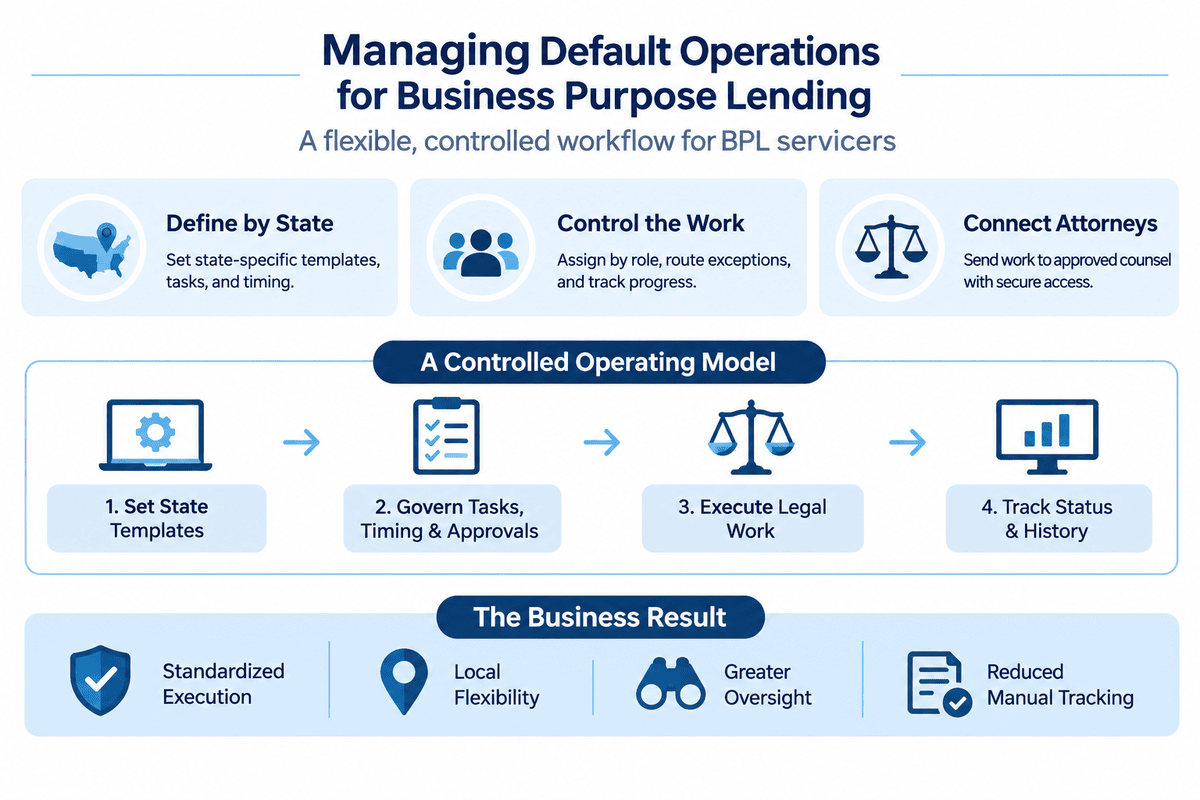
Business Purpose Lending (BPL) servicers require flexibility, meaning they should avoid a one-size-fits-all default process. MortgageFlex LoanQuest offers a controlled workflow designed for the speed and portfolio diversity of BPL servicing. The platform gives authorized administrators control over state-specific foreclosure workflows while integrating approved attorneys into a secure process.
Why It Fits the BPL Operating Model
- Define by State: Administrators can maintain state-specific templates and configure necessary tasks or milestones. The system allows teams to set timing and dependencies while applying holds, approvals, and close reasons.
- Control the Work: Servicers can assign work by role, user, or partner. Teams can route exceptions for internal review and monitor pending, overdue, and completed work. The software preserves comments, documents, and complete history.
- Connect Attorneys: Lenders can restrict access to assigned loans and send work directly to approved outside counsel. Servicers receive authorized status updates, which reduces reliance on email and manual tracking.
A Controlled Operating Model
- The servicer defines state templates and standards.
- The workflow governs tasks, timing, and approvals.
- The attorney executes assigned legal work.
- MortgageFlex tracks the status, history, and oversight.
The Business Result
MortgageFlex helps BPL servicers standardize execution while preserving local flexibility. The platform strengthens oversight of third-party activity and reduces fragmented tracking across spreadsheets and law firm portals. This ensures clearer evidence of tasks, decisions, and completed milestones. Ultimately, the software does not dictate the process; the servicer defines it, MortgageFlex governs it, and approved counsel works within it.
Frequently Asked Questions About Loan Servicing Software for Private Lenders
1. What is loan servicing software for private lenders?
Loan servicing software is a technology platform that helps private lenders manage loan accounts after origination. It can support activities such as payment tracking, interest and fee calculations, balance management, borrower records, document management, and portfolio reporting throughout the loan term.
2. How does loan servicing software help private lenders manage growing portfolios?
Loan servicing software centralizes loan information and supports repeatable workflows for routine servicing activities. This can reduce reliance on manual spreadsheet updates, make payment records easier to monitor, and help teams manage more accounts without having to coordinate information across multiple disconnected tools.
3. Can loan servicing software handle bridge and fix-and-flip loans?
Yes, some loan servicing platforms support bridge and fix-and-flip loans, including loans with different terms, repayment schedules, interest structures, and maturity dates. Lenders should verify that a platform can accommodate their specific loan configurations and, where relevant, track draw requests and disbursements.
4. How does servicing software automate payment and fee tracking?
Depending on its capabilities, servicing software can maintain payment schedules, record transactions, track outstanding balances, and support payment posting and reconciliation workflows. It can also be configured to calculate or track interest, late charges, and other loan-specific fees. Accurate results depend on correct loan setup and system configuration.
5. What features help private lenders manage investor reporting?
Private lenders should look for investor-level reporting, payment allocation records, transaction histories, balance tracking, and distribution reporting where applicable. These capabilities can help organize information related to investor-funded loans and provide clearer records of payment activity. The software should also align with the lender's investment agreements and reporting obligations.
6. Is cloud-based loan servicing software suitable for private lenders?
Cloud-based loan servicing software can be suitable for private lenders seeking to reduce dependence on lender-managed servers and support access to servicing applications across locations. However, lenders should evaluate the provider's security controls, data protection practices, backup policies, disaster recovery arrangements, and shared security responsibilities before selecting a platform.
7. What should private lenders consider before choosing a loan servicing platform?
Private lenders should evaluate loan product flexibility, payment and fee management, draw tracking, investor reporting, document management, integrations, security, and reporting capabilities. They should also review implementation support, data migration requirements, scalability, vendor service commitments, and total cost of ownership to determine whether the platform fits their current and future needs.
Lester Dominick
Founder & CEO
As President and Founder of MortgageFlex Systems, I leverage over 40 years of expertise to drive AI-powered innovation across the lending lifecycle.