Why Modern Lenders Are Choosing a Cloud-Based Loan Origination System?
Nov 11, 2026
Technology modernization is becoming an important business priority for mortgage lenders. According to Fannie Mae's 2025 Mortgage Lender Sentiment Survey, business process streamlining, cost reduction, and consumer-facing technology ranked among lenders' leading priorities. As lending operations evolve, maintaining legacy infrastructure can make it harder to address these priorities while managing technology costs and operational complexity.
A cloud-based loan origination system offers an alternative to traditional on-premise infrastructure. For lenders looking to modernize their technology environment, cloud adoption presents an opportunity to rethink how lending operations are managed and supported.
This guide explores the key benefits of cloud-based loan origination systems, including scalability, simplified maintenance, API integrations, remote accessibility, and data security. It also examines the factors lenders should consider when evaluating cloud adoption for long-term business growth.
The Hidden Costs of On-Premise Loan Origination Systems
Maintaining an on-premise loan origination system involves more than the initial investment in hardware and software. The challenge is reflected in mortgage industry research. According to HFS Research's 2025 study of 467 banking and non-banking mortgage lenders, 36% identified legacy technology debt as their biggest obstacle to business transformation. For lenders, this highlights how aging technology can become a financial and operational constraint.
- Infrastructure and Hardware Expenses: On-premise systems require lenders to invest in servers, storage, networking equipment, data center facilities, and related infrastructure. These assets also require maintenance, replacement, and capacity planning. As loan volumes and data requirements grow, organizations may need additional hardware to maintain performance, increasing capital expenditure and ongoing operating costs.
- IT Maintenance and Staffing Requirements: Internal IT teams must manage infrastructure availability, system monitoring, security patches, backups, troubleshooting, and vendor coordination. This requires dedicated technical resources and ongoing training. Time spent maintaining existing systems can also reduce the capacity available for modernization and other strategic technology initiatives.
- Software Upgrades and Downtime: Software upgrades may require planning, testing, internal coordination, and maintenance windows. Older systems with custom configurations can make updates more complex. Lenders must also account for potential service interruptions during upgrades, patches, or infrastructure maintenance, particularly when multiple applications depend on the same environment.
- Integration Limitations and Technical Debt: Legacy systems may rely on older interfaces, custom connections, or batch-based data transfers to communicate with third-party applications. Maintaining these connections can increase development effort and make future upgrades more difficult. Over time, these dependencies contribute to technical debt and restrict the lender's ability to adopt new technologies.
Key Benefits of a Cloud-Based Loan Origination System
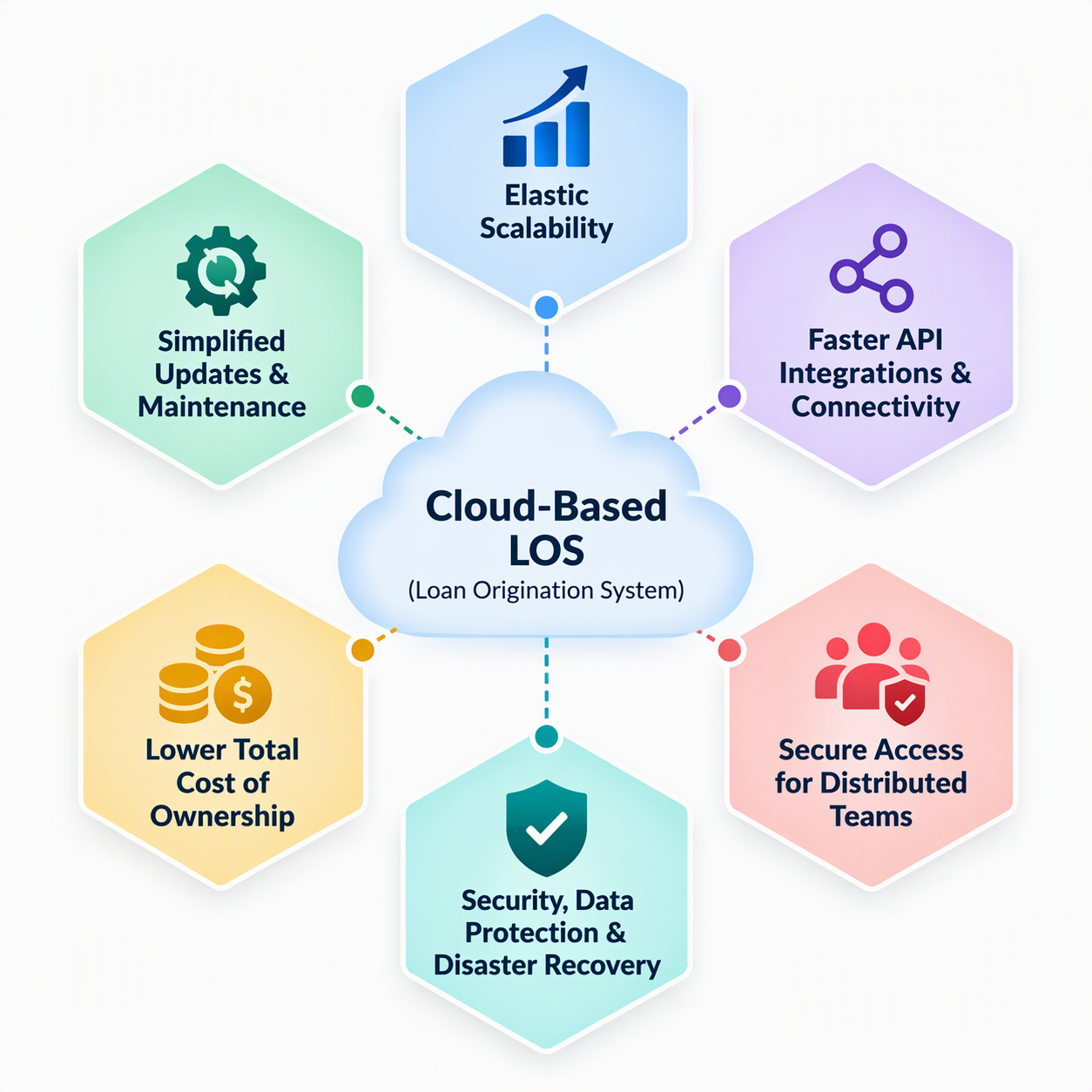
A cloud-based loan origination system helps lenders move beyond the limitations of traditional infrastructure. From handling fluctuating application volumes to simplifying system maintenance and improving connectivity, cloud adoption offers several operational advantages. Here are six key benefits for modern lending organizations.
1. Elastic Scalability to Handle Changing Loan Volumes: Loan application volumes fluctuate with market conditions, interest rates, and seasonal demand. Cloud infrastructure allows lenders to adjust computing and storage capacity based on workload requirements, reducing dependence on additional physical hardware. This flexibility can help accommodate peak processing periods and support business expansion.
2. Simplified Software Updates and Maintenance: Cloud-based deployment can shift infrastructure maintenance, security patching, and software updates to the service provider, depending on the hosting agreement. This reduces the internal IT team's infrastructure management responsibilities and simplifies upgrade coordination. Lenders should still review release schedules, testing procedures, and planned maintenance windows.
3. Faster API Integrations and Greater Connectivity: Cloud platforms with well-documented APIs can simplify connections with credit providers, income verification services, e-signature applications, document management tools, and servicing systems. These integrations support data exchange between lending applications and can reduce manual transfers. Actual connectivity depends on available APIs, supported connectors, and integration requirements.
4. Secure Access for Distributed Lending Teams: Browser-based cloud systems allow authorized employees to access supported lending applications from different locations through an internet connection. Loan officers, processors, underwriters, and servicing teams can work across locations without depending exclusively on office-based infrastructure. Authentication, role-based permissions, and endpoint security remain essential.
5. Cloud Security, Data Protection, and Disaster Recovery: Cloud infrastructure can provide access to encryption, identity management, backup, monitoring, and disaster recovery capabilities. These controls help lenders protect sensitive borrower information and prepare for service disruptions. However, security depends on implementation and shared responsibilities. Lenders should verify recovery objectives, backup policies, and incident response procedures.
6. Lower Total Cost of Ownership: Cloud deployment can reduce spending on physical servers, hardware replacement, and infrastructure maintenance by shifting certain responsibilities to the service provider. Recurring subscription or hosting fees may also simplify budgeting. However, lenders should compare implementation, migration, licensing, integration, storage, and support costs over a three- to five-year period.
Why Consider MortgageFlex LoanQuest?
MortgageFlex's LoanQuest brings together cloud-native lending technology and capabilities designed to support the benefits discussed above. Its key features include:
- Cloud-Native Technology for Flexible Lending Operations: LoanQuest is a cloud-native platform designed to support lenders as their operational needs and loan volumes change. It provides a technology foundation without requiring lenders to manage the platform through traditional on-premises infrastructure.
- Unified Origination, Servicing, and Default Management: LoanQuest supports multiple stages of the loan life cycle within one platform. By bringing origination, servicing, and default management together, it gives lenders a connected environment for managing lending operations.
- Integrated Workflows and System Connectivity: The platform includes workflow automation, integrations, and document management capabilities. These features support process coordination and information exchange across lending systems, helping lenders reduce dependence on disconnected tools and manual workflows.
- Reporting and Governed AI Capabilities: LoanQuest also offers reporting and governed AI capabilities to support operational visibility and the use of AI within lending workflows. These tools give lenders additional options for managing information and exploring process improvements with appropriate oversight.
Ready to modernize your lending operations? Explore the MortgageFlex LoanQuest Platform to see how its cloud-native technology supports the loan life cycle. Request a demo to discover how LoanQuest can support your lending goals.
Frequently Asked Questions About Cloud-Based Loan Origination Systems
1. What is a cloud-based loan origination system?
A cloud-based loan origination system (LOS) is software hosted on cloud infrastructure that helps lenders manage the loan application and approval process. It can support tasks such as application intake, document collection, underwriting workflows, and loan processing through an internet-accessible platform.
2. How is a cloud-based loan origination system different from an on-premise LOS?
An on-premise LOS is hosted on infrastructure managed by the lender, while a cloud-based LOS runs on cloud infrastructure. Cloud deployment can reduce the need for lenders to maintain physical servers and manage certain infrastructure updates, depending on the provider's hosting and support arrangements.
3. Can a cloud-based LOS handle fluctuations in loan application volumes?
Yes. Cloud infrastructure can allow computing and storage resources to scale according to workload demands. This can help lenders accommodate changes in application volumes without purchasing additional physical hardware, subject to the platform's architecture and service limits.
4. How do cloud-based loan origination systems integrate with other lending applications?
Many cloud-based LOS platforms use APIs and supported connectors to exchange information with third-party applications. These may include credit reporting, income verification, electronic signature, document management, and loan servicing systems. Integration availability depends on the platform and the specific applications involved.
5. Is a cloud-based loan origination system secure?
A cloud-based LOS can include security capabilities such as data encryption, access controls, authentication, monitoring, and backups. However, security depends on how these controls are implemented and maintained by both the provider and the lender. Lenders should assess the provider's security practices and their own responsibilities for protecting borrower information.
6. What should lenders evaluate before moving to a cloud-based LOS?
Lenders should assess scalability, integration capabilities, data security, disaster recovery, implementation requirements, vendor support, and total cost of ownership. They should also review data migration plans, service-level commitments, system availability, and how the platform supports their loan products and workflows.
7. Can a cloud-based lending platform support more than loan origination?
Yes. MortgageFlex LoanQuest combines origination, servicing, and default management with capabilities such as workflow automation, document management, integrations, reporting, and governed AI.
Lester Dominick
Founder & CEO
As President and Founder of MortgageFlex Systems, I leverage over 40 years of expertise to drive AI-powered innovation across the lending lifecycle.